 (one minute astronomer)
Wednesday, May 19, 2010


Friday, May 7, 2010
Research Question 3- How long does it take for a star to form?
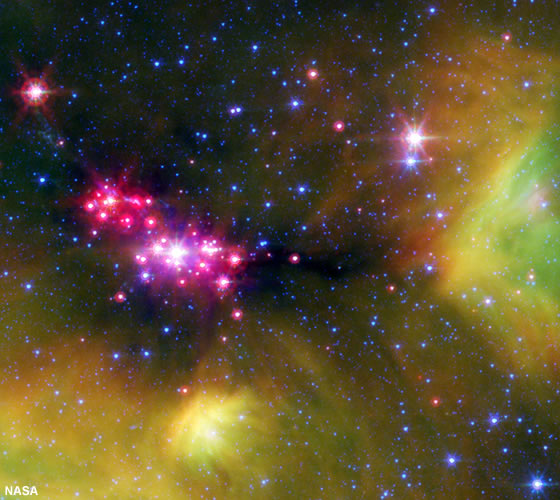
Stars form when a gravitational force of gases contracts and collapses onto itself. This process is very slow. Scientists estimate that 10 - 20 new stars form each year in the Milky Way. There was most likely a very intense burst of activity when the Universe was young, but over time this has decreased. When two galaxies pass by one another, there are interactions that may cause "starburst" activity, more prolific star-forming activity. (Green Answers)
Thursday, May 6, 2010
Research Question 2- What is the life cycle of a star?

The first stage of a star is the nebulae. The nebulae are made up of huge clouds of dust and gas. (Buzzle) The amount of gas and dust in a star determines the size of the star. As the star gets more dust and gas, gravity is forming in the star and a protostar is made. The stars temperature is about 15,000,000 degrees celsius. Nuclear fusion begins and the star starts to give off light. The star is in the main sequence. The main sequence is where most of the stars life is spent. A red giant is formed when the hydrogen in its core depletes. The core then loses stability and expands and becomes less bright. The star then will become a white dwarf. After the star loses all its energy it becomes a black dwarf. The stars next stage is a neutron star. The last stage is a black hole.
Tuesday, May 4, 2010
Research Question 1- What are the types of stars?

There are many different types of stars. Before a star is formed the star is called a protostar. It is made up of gas that has been broken down into a giant cloud. (University Today) Most of the stars life is in the main sequence. Almost all the stars in our galaxy are in the main sequence. There are a couple that are not but they are all around the same size.A red giant star is formed when a star consumed the hydrogen in its core. When it is a red giant star it can be up to 100 times bigger than in the main sequence. (University Today) The next stage is a white dwarf. Then a neutron star, which is about 1 to 2 times the mass of the sun. Then the last type is a supergiant. They are the largest stars in the universe.
Subscribe to:
Comments (Atom)